Car-ready solar powered coolers keep beverages fresh and meals safe without relying on constant access to AC outlets. This guide highlights five top options that blend reliable cooling, portability, and optional solar charging for true off‑grid capacity. Each choice supports car travel, road trips, and outdoor adventures with varying capacities, battery configurations, and power options. Read on to compare performance and select the best fit for your next journey.
Summary table of chosen products:
| Product | Brand | Key Benefit | Power Options |
|---|---|---|---|
| Anker SOLIX EverFrost 2 40L Cooler | Anker | Wide temperature range and fast frost flow; long battery life | AC/DC or Solar; 288Wh battery (two batteries available) |
| EENOUR D10 12V Car Refrigerator | EENOUR | Detachable 171Wh battery with up to 30 hours cooling | DC 12/24V, AC, detachable battery, solar capable |
| BougeRV 12V Car Refrigerator | BougeRV | Fast cooling to 32℉; low power consumption | DC 12/24V, AC; compact and portable |
| EUHOMY 12V Car Refrigerator | EUHOMY | App control, fast cooling, magnetic seal design | 12/24V DC, AC; app control |
| EENOUR D18 12V Car Refrigerator | EENOUR | Battery and solar capable; rapid cooling | DC 12/24V, AC; detachable battery option |
Anker SOLIX EverFrost 2 40L Cooler

Product features center on ice-free cooling with a broad -4°F to 68°F range, ensuring beverages stay frozen and food remains chilled without melting ice. A key highlight is even and fast frost flow cooling: the unit can drop from 77°F to 32°F in about 15 minutes, helping avoid warm surprises during long drives. With two 288Wh batteries, it can sustain cooling for extended trips, offering approximately 52 hours of operation on a single battery and 4.3 days with two batteries. It also supports AC/DC or solar power for flexible, off-grid charging.
EENOUR D18 12V Car Refrigerator, 19Qt/18L

The D18 model offers a compact 19Quart capacity with a detachable 171Wh battery, delivering up to 24 hours of cooling at 32°F when powered independently. It provides five versatile power options, including DC 12/24V, AC, detachable battery, solar panel + battery, and power station + solar panel. It chills from 77°F to 32°F in about 10–15 minutes and to -4°F in roughly 25 minutes. A fluorine-free compressor and 2″ thick EPDM insulation support strong thermal efficiency, helping contents stay cold even when power is limited.
EUHOMY 12V Refrigerator, 19QT

EUHOMY’s 19Quart cooler is equipped with 100/240V AC and 12/24V DC adapters for home or car use. It features a 2-year tech support promise and a Bluetooth/app control option for remote management. The unit’s powerful compressor lowers temperatures quickly—from 77°F to 32°F in about 15 minutes—and its magnetic seal design enhances insulation and cooling efficiency. The lid’s magnetic seal helps maintain cold air while providing easy access during travel.
BougeRV 12V Car Refrigerator
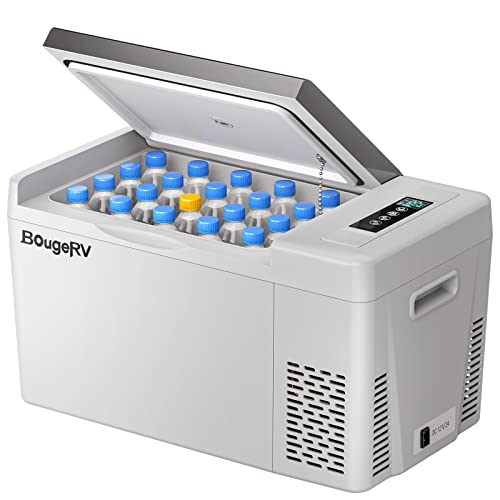
BougeRV’s CR22 model emphasizes fast cooling with compressor technology, achieving 32°F in about 15 minutes and as low as -5°F within about 50 minutes. It’s designed for low power consumption in ECO mode and remains efficient even when running at maximum power. The 23 Qt capacity makes it a practical choice for road trips, trucks, RVs, and camping. The package includes DC and AC cords and a user manual, along with reliable 2-year tech support from BougeRV.
EENOUR D10 12V Car Refrigerator

The D10 variant uses a detachable 171Wh battery, delivering up to 30 hours of cooling at 32°F. Five power options include DC 12/24V, AC, detachable battery, solar panel + battery, and power station + solar panel, allowing solar charging while operating the fridge. Cooling from 77°F to 32°F takes about 10 minutes, while reaching -4°F occurs around 18 minutes. The unit features a 2″ thick EPDM interior for improved insulation and sealing, with a compact design suitable for two-person trips or short tours.
Buying Guide: Key Considerations for Solar Powered Car Coolers
- Temperature range and cooling speed: Look for models that reach 32°F quickly and maintain stable temps across a wide range. Faster cooling helps preserve perishables on long drives.
- Power options and solar compatibility: A good solar-ready cooler should offer multiple charging paths (DC car, AC, detachable battery, solar panels). Consider whether the battery is included, its capacity, and whether you can add solar panels to extend off-grid use.
- Battery capacity and runtime: Battery capacity (in Wh) determines how long the cooler can operate without external power. Dual-battery setups extend sessions, important for multi-day trips.
- Insulation and sealing: Thick insulation (EPDM or similar) reduces temperature loss and improves efficiency. Magnetic seals can help maintain cold air and extend cooling performance when opening the lid.
- Portability and size: Choose a capacity that fits your vehicle and meal plans. Larger models offer more storage but add weight and space considerations for cars, SUVs, or vans.
- App and control features: Some models include Bluetooth or app control for remote temperature management, which can be convenient for RVs and campers.
- Durability and warranty: Check build quality, compressor reliability, and the availability of tech support or a warranty period to ensure long-term value.
- Ease of use and maintenance: Consider how easy it is to set temperature, clean, and replace parts like batteries or solar panels when needed.
- Noise level: Some portable coolers operate with audible compressor noise. If you’ll use the unit in a car or campsite, lower noise may be preferable.
- Price vs. value: Compare initial cost, battery options, and potential solar add-ons to gauge total ownership cost over the product’s lifetime.