If you’re outfitting a car rooftop for off-grid power, you need reliable, compact, and efficient solar panels. This guide highlights five top options that balance size, efficiency, and ease of install for vans, RVs, boats, and other mobile setups. Each product emphasizes high conversion efficiency, lightweight design, and compatibility with 12V or 24V systems. Read on to compare features, installation considerations, and what to look for when shopping for a solar panel designed for moving roofs and tight spaces.
Summary table of chosen products:
| Product | Key Strength | Voltage | Approx. Efficiency |
|---|---|---|---|
| Renogy Solar Panels 200W N-Type (24V) | Compact, high efficiency (25%), flexible mounting | 24V | 25% |
| Renogy 200W ShadowFlux Anti-Shading N-Type (12V/24V) | Anti-shading tech, reduced hotspots | 12V / 24V | 25% |
| Renogy Solar Panel 200W 24V | Space-saving for tight roofs | 24V | 25% |
| Rvpozwer 200W N-Type (18BB) | High efficiency, sturdy mounting | 12V | 25% |
| SOLPERK Solar Panel Kit 20W | Compact trickle charging, controller included | 12V | 21-30% (cell efficiency) |
Renogy 200W N-Type Panel For 24V Systems

This Renogy 200W N-Type panel is designed for Class B vans and other compact roof spaces. It measures smaller and lighter than earlier models while delivering the same output, making it well-suited for tight rooftop spots on campers and RVs. The cell technology supports higher efficiency, with a focus on reducing microcracks and temperature-related losses, helping performance hold up in hot climates. The 24V compatibility lets it pair with versatile battery configurations, enabling flexible wiring for mobile power systems.
Renogy ShadowFlux 200W N-Type Panel (12V/24V)

Renogy’s ShadowFlux anti-shading technology helps maintain power output even when part of the panel is shaded by branches, buildings, or roof features. The panel uses advanced 16BB N-Type cells to reach about 25% efficiency, reducing hot spots and micro-cracks that can shorten lifespan. It’s compact and lighter than similar PERC panels, making it a practical choice for smaller roof areas and mobility-focused installations where space is at a premium but reliability is non-negotiable.
Renogy 200W 24V Solar Panel
This Renogy 200W 24V panel emphasizes a compact footprint with strong efficiency (25%) through 16BB N-Type cells. It’s designed for versatile rooftop integration on vans and RVs, supporting both 12V and 24V battery systems. The design prioritizes minimizing current losses, so you’ll see more usable power even when the roof is partially shaded or weathered. Comfort with installation is enhanced by its compatibility with common mounting hardware used in mobile solar setups.
Rvpozwer 200W N-Type 18BB Panel

The Rvpozwer 200W panel features 18BB technology for improved efficiency and longevity. With 25% cell efficiency, it is designed to provide reliable daily output for off-grid setups on rooftops. The panel includes straightforward pre-drilled holes for mounting, making installation flexible across various vehicle types. Its N-Type construction contributes to durable performance in varying weather conditions, which is beneficial for roving lifestyles and remote deployments.
SOLPERK 20W Solar Panel Kit
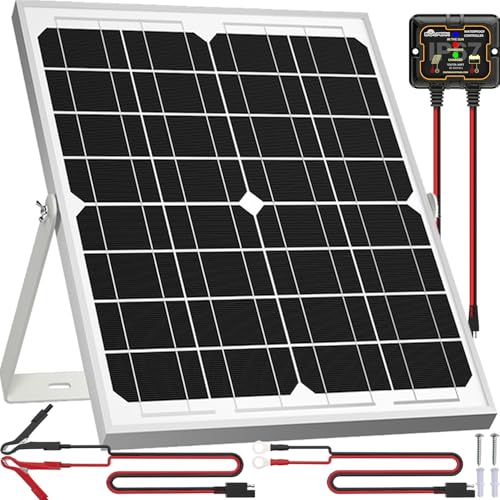
This SOLPERK kit adds a compact 20W panel with 21-30% cell efficiency, a 8A smart charge controller, and a durable mounts-ready design. It’s designed for smaller 12V battery charging and maintenance on boats, cars, RVs, or portable systems. The kit includes features like overcharge and reverse polarity protection, and a pair of USB outputs to charge mobile devices. It’s best used as a supplemental panel or for prioritizing occasional top-off charging in space-constrained rooftops.
Buying Guide: Key Considerations For Car Rooftop Solar
When choosing a solar panel for a car roof, several factors influence long-term performance and satisfaction. Here are the main considerations to help you compare options objectively.
- Cell technology and efficiency: Look for N-Type cells or similar high-efficiency architectures (around 25%). This reduces heat-related losses and microcracking, improving reliability in mobile environments.
- Voltage compatibility: If your vehicle’s electrical setup uses 12V batteries, prioritize 12V panels or ensure a compatible MPPT/PWM controller. For larger roof spaces with higher storage, 24V panels can be advantageous with suitable controllers.
- Size, weight, and fit: Space on a car roof is limited. Panels described as compact or lightweight help you maximize the usable roof area without adding undue weight.
- Shading resilience: Shadows from vents, antennas, or roof lines can impact output. Anti-shading technology and proper panel layout reduce performance dips.
- Durability and weather resistance: Look for tempered glass, robust frames, and sealed junction boxes to withstand wind, rain, and road debris.
- Ease of installation: Pre-drilled mounting holes, flexible mounting hardware, and included controllers simplify on-roof installation and maintenance.
- System integration: Plan for battery type, charge controller, and wiring. Compatibility with 12V and 24V batteries offers flexibility for different rigs and future upgrades.
- Expandable kits: If you anticipate adding more panels later, choose systems that scale with additional modules and compatible controllers.
In practice, a 12V system paired with a 20W to 200W panel can be ideal for small rigs or as a top-off source, while a 24V system with a 200W panel trades more power for larger setups like full-time van life or RVs with higher energy demands. When evaluating options, consider your roof space, typical climate, and how often you drive in shade-prone environments to balance efficiency with cost and installation effort.