The following guide highlights five top roof-mounted air conditioners that suit trucks, RVs, vans, campers, and trailers. Each option emphasizes efficiency, durability, and off-grid capability. Below, you’ll find concise product snapshots, key features, and practical buying insights to compare cooling power, power sources, and installation needs.
| Product | BTU Range | Power Source | Notable Feature |
|---|---|---|---|
| RV Air Conditioner, 12V 10000 BTU Rooftop (OutEquip) | 10,000 BTU | 12V battery powered | Integrated heater option |
| OutEquip Pro 12V 10000 BTU Rooftop | 10,000 BTU | 12V battery powered | Off-grid cooling, long battery life |
| Furrion Chill HE 15K | 15,000 BTU | AC power (115V) | Dual fan motors, ClimateSmart |
| Vlim RV Air Conditioner 9500 BTU | 9,500 BTU | 12V battery/inverter compatible | Inverter-based efficiency and quiet operation |
| FOGATTI InstaCool 13,500 BTU | 13,500 BTU | 115V AC plus 12V DC | All-in-one design with eco refrigerant |
The table above provides a quick comparison of five roof-mounted options that are well-suited for trucks and RVs. Each product supports different power setups and installation needs, so consider your typical travel conditions and whether you prioritize off-grid capability or higher cooling capacity for larger spaces.
OutEquip 12V Rooftop Air Conditioner With Heater

Efficient cooling: This 10,000 BTU unit cools RV spaces quickly, aiming for comfortable temps in about 15 minutes. It includes a 4,500 BTU heater for mild, transitional climates, making it a versatile year-round option for smaller spaces. Durability features include UV-stabilized ABS housing, a zinc-coated condenser, and EPDM foam gasketing to withstand harsh conditions. The design emphasizes reliability for off-grid or mixed power scenarios, though the heater should not be used as a primary heat source in extreme cold.
OutEquip Pro 12V 10000 BTU Rooftop AC
Off-grid cooling with extended battery life: The OutEquipPro 12V unit delivers 10,000 BTU and is designed for battery-powered operation. When parked, a 12V 480Ah battery can deliver up to about 8 hours of cooling, while a 12V 600Ah setup can offer roughly 10 hours. It shares the same durable build as the heater-enabled version, featuring UV-stabilized materials, EPDM foam, and a robust condenser, engineered to withstand challenging outdoor environments.
Furrion Chill HE 15K Low-Profile RV AC

High-capacity and efficiency: The 15,000 BTU unit uses two fans for rapid air distribution and enhanced cooling performance in small to mid-sized RVs. It employs ClimateSmart and Vibrationsmart features to adapt cooling with reduced vibrations. Energy efficiency is emphasized with a relatively low overall power draw for its class, making it suitable for setups with steady AC power access although it remains compatible with off-grid use when paired with a suitable power source.
Vlim 9,500 BTU 12V RV Air Conditioner

Inverter-driven efficiency and quiet operation: The Vlim unit offers 9,500 BTU with advanced inverter technology. It dynamically adjusts cooling capacity to demand, saving energy and extending battery life—up to about 10 hours of use on a supported battery. The system is designed for quiet performance (low decibel levels) to minimize cabin disturbance while maintaining even air distribution for comfortable sleeping and living areas in RVs or trailers.
FOGATTI InstaCool 13,500 BTU RV AC
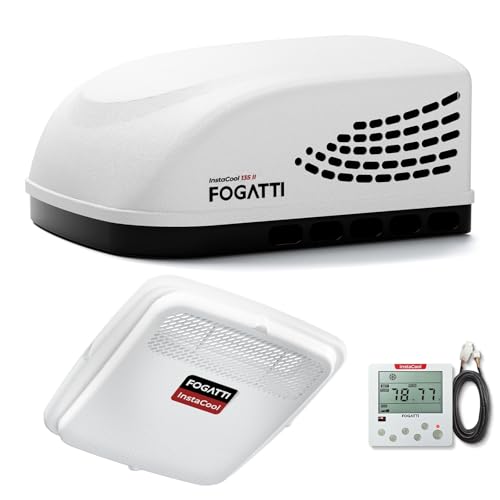
All-in-one design with eco refrigerant: The InstaCool model delivers 13,500 BTU of cooling power, designed for efficient performance in campers and trailers. It requires both 115V AC and 12V DC power, enabling flexible operation in powered and off-grid scenarios. The cooling system uses eco-friendly R32 refrigerant and features dual high-efficiency compressors to balance fast cooling with energy savings, helping to manage power load in mobile setups.
Buying Guide: Key Purchase Considerations
- Power compatibility: Determine whether your vehicle supports 12V battery operation, or if you’ll rely on AC power (115V) with an onboard generator or shore power. Some models offer dual power modes, while others are optimized for off-grid use with large battery banks.
- Cooling capacity vs. space: Match BTU output to your RV’s or truck’s interior size. Higher BTU units cool faster but may demand more electrical power. For compact cabins, 9,500–10,000 BTU units are often sufficient; for mid-size spaces, 13,500–15,000 BTU units provide faster cooling.
- Heat capability: If you expect year-round use, consider models with integrated heat functionality or heater compatibility. Note that some products offer a separate heater option or require auxiliary heating in cold weather.
- Installation and footprint: Check roof opening dimensions and clearance height. Some units are low-profile, reducing wind resistance and bulk on the roof, but may require professional installation for best sealing and vent routing.
- Durability and weather resistance: Look for UV-stabilized housings, weather-sealed gaskets, and corrosion-resistant condensers to ensure long-term reliability in varying climates and road conditions.
- Noise and comfort: Inverters and dual-fan designs can reduce operational noise and improve air distribution, contributing to a quieter cab experience.
- Energy efficiency: Inverter-based or variable-speed compressors tend to consume less energy, extending battery life for off-grid setups and reducing generator runtime.
- Maintenance and service: Favor brands with accessible spare parts and clear installation instructions. Consider warranty terms and expected service life when evaluating total ownership costs.