For car listeners seeking deep, crisp bass without complex wiring, passive subwoofers paired with a suitable amplifier offer a clean, flexible solution. The following selections emphasize shallow-mount designs, efficient power handling, and durable construction to fit a variety of vehicles and installations. Each option listed here works well with aftermarket amps and sealed enclosures to deliver dependable, high-fidelity bass on the road.
| Product | Brand | Approx. Power Handling | Mounting Notes |
|---|---|---|---|
| PIONEER A-Series TS-A2000LB | PIONEER | 250W nominal / 700W max | 8” shallow-mount, sealed enclosure included |
| ORION Cobalt CDF12 | ORION | 2000W max total (enclosure + sub) | 12” down-fire enclosure, slim profile |
| ORION Cobalt CDF10 | ORION | 1600W max total (enclosure + sub) | 10” down-fire enclosure, slim profile |
| KICKER TRTP 12” | KICKER | High-output with passive radiator design | Thin-mount, down-firing configuration |
| KICKER 48TRTP82 | KICKER | High-efficiency, 2-Ohm system | 8” thin down-firing, compact enclosure |
Note: This table highlights general specs and mounting considerations. Confirm compatibility with your vehicle’s audio system and preferred amplifier before purchase.
Pioneer A-Series TS-A2000LB 8” Subwoofer

The TS-A2000LB is designed to pair with Pioneer’s A-series full-range speakers, delivering a balanced bass response with both agility and depth. It features a sealed enclosure with a robust cone made from Glass-Fiber & Mica Reinforced IMPP material to maintain rigidity under dynamic bass signals. With 700W max and 250W nominal power, it supports customizable bass when connected to an external amplifier, enabling precise control over low-end performance suitable for cars with limited mounting depth.
ORION Cobalt CDF12 Passive Down-Firing Subwoofer Enclosure
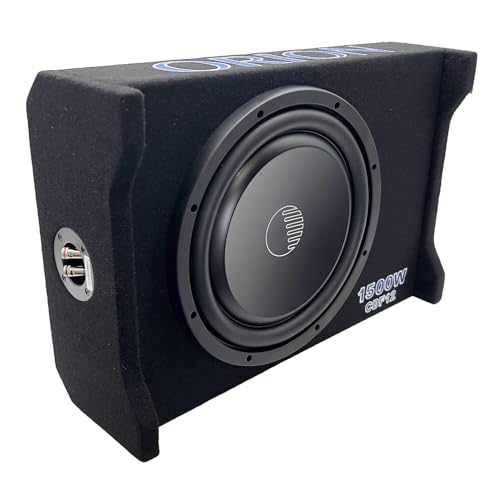
The CDF12 combines a 12” down-fire enclosure with a passive subwoofer designed to maximize bass response when paired with aftermarket amplifiers. The down-fire design helps push low-frequency output while maintaining secure placement in the vehicle. Built with MDF, an airtight seal, and a durable carpeted finish, this enclosure minimizes vibrations to deliver clean, controlled bass across listening levels.
ORION Cobalt CDF10 Passive Down-Firing Subwoofer Enclosure

The 10” down-fire enclosure from Orion is designed to enhance bass response while remaining compatible with a broad range of aftermarket amplifiers. Its slim profile fits tight installations, and the sealed enclosure minimizes unwanted vibrations to keep bass tight and responsive. The MDF construction and airtight seal contribute to a clean low-end presence even in smaller vehicle cabins.
KICKER TRTP 12” Thin Down Firing Subwoofer

The TRTP 12” passive radiator subwoofer features forced-air cooling to extend reliability and reduce thermal compression. Its thin-mount design and down-firing configuration allow installation in compact spaces, such as under seats or in narrow cargo areas. The included high-output reFLEX passive radiator enhances bass output, delivering deeper low-end without taking up excessive space.
KICKER 48TRTP82 8-Inch Thin Subwoofer

This 8-inch, ultra-thin subwoofer unit focuses on a compact footprint while delivering noticeable low-end presence. Its down-firing design with a passive radiator setup helps maximize bass extension in tight spaces, making it suitable for vehicles with limited cargo area height. The component is designed for compatibility with aftermarket amplifiers and can contribute to a fuller car audio experience when correctly integrated.
Buying Guide: Key Considerations For Choosing A Passive Car Subwoofer
When selecting a passive subwoofer for a car, consider how it integrates with your existing system and your installation constraints. These factors help ensure you get the expected bass performance without overhauling your setup.
- Power Handling and Amplification: Passive subwoofers rely on an external amplifier. Match the sub’s nominal power rating with your amplifier’s output to avoid under- or over-powering. Check total system headroom to preserve bass clarity during loud passages.
- Enclosure Type And Mounting Depth: Sealed enclosures emphasize fast, accurate bass with minimal port noise. For shallow spaces, consider compact, down-firing designs. Measure available depth and width to ensure the enclosure fits without interference with seats or panels.
- Subwoofer Size And Vehicle Space: Larger drivers (10”–12”) deliver deeper bass but require more mounting space. Smaller 8” subs can offer solid performance with less intrusion. Choose based on desired bass extension and cargo-room availability.
- Cone Material And Build Quality: Cones made from reinforced composites (such as Glass-Fiber & Mica Reinforced IMPP) tend to be rigid and durable, reducing distortion under high excursion. Durable enclosures with airtight seals help minimize unwanted vibrations.
- Installation Complexity: Shallow-mount and down-firing designs simplify installation in compact cars but may require careful placement to optimize air movement. If wiring depth is a constraint, plan for an orderly routing path for power, ground, and remote turn-on connections.
- Compatibility With Existing Components: Ensure the subwoofer can integrate with your current head unit, amp, or speaker system. Consider impedance compatibility (2-ohm vs. 4-ohm) and whether the amplifier supports stable operation with your chosen sub.
- Acoustic Objectives: Decide whether you want tight, punchy bass or deep, room-filling low-end. Sealed enclosures generally provide tighter control, while certain down-firing configurations can boost perceived depth in compact cabins.
- Durability And Warranty: Look for MDF or reinforced enclosures and high-quality grilles. A warranty reflects confidence in long-term performance, especially for components exposed to vehicle vibrations.
These considerations help balance space, power, and sound goals. A well-matched passive subwoofer and amplifier configuration provides reliable bass performance across driving conditions without compromising overall system integrity.