When a vehicle sits idle, parasitic battery drain can leave you stranded. A dead switch, or battery disconnect switch, helps protect the electrical system by safely isolating the battery. This guide reviews five top-rated options, covering installation, performance, and safety considerations to help you choose the right switch for cars, trucks, and RVs.
Summary of Selected Products
| Product | Brand | Voltage Range | Continuous Current | Key Benefit |
|---|---|---|---|---|
| Remote Battery Disconnect Switch 12v | DZSSCY | 12V | 250A | Remote operation and anti-theft protection |
| Joinfworld Top Post Battery Disconnect Switch | Joinfworld | 12-48V | 250A DC Continuous | Easy negative-terminal installation |
| Spurtar Battery Disconnect Switch (200A) | Spurtar | 12-48V | 200A | Simple on/off with clear indication |
| Nilight Battery Switch 90015A | Nilight | 12-48V | 275A continuous | Heavy-duty ABS housing and reliable isolation |
| PTPUO Top Post Battery Disconnect Switch | PTPUO | 12-48V | Varies | Flexible installation options and strong conductivity |
Remote Battery Disconnect Switch With Remote Kill Capability
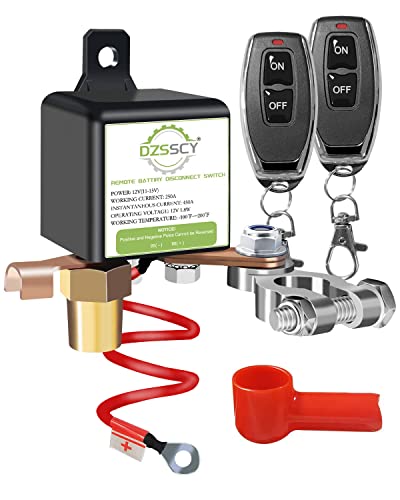
The DZSSCY remote battery disconnect switch provides a negative-terminal disconnection for rapid battery isolation. It is designed to prevent battery drain while also reducing theft risk by enabling remote operation. With instantaneous current up to 450A and a rated continuous current of 250A, this unit aims to protect circuits from long-term parasitic draw. Installation emphasizes connecting the negative terminal to the switch and wiring to the battery’s positive side, while minimizing cabling complexity. The product emphasizes extended battery life and robust construction with pure copper wiring for improved conductivity.
Joinfworld Top Post Battery Disconnect Switch

This 12V-48V top-post battery disconnect switch offers a straightforward On/Off two-position control with a rating of 250A DC continuous and 1000A DC cranking. It includes a negative battery clamp and a tapered post, simplifying installation on the negative side and improving electrical conductivity with copper components. The ABS plastic housing provides durability and safety in demanding environments, including cars, RVs, boats, and other vehicles requiring reliable power isolation.
Spurtar 200A Battery Disconnect Switch

Spurtar’s 200A battery disconnect switch is designed to safely isolate 12-48V DC systems, providing a reliable method to prevent parasitic drain. The unit features a clearly indicated on/off plate, a smooth toggle action, and installation that’s compatible with a variety of vehicles, including cars, trucks, and boats. Its construction emphasizes safe operation and simple maintenance, making it a practical choice for drivers seeking dependable circuit isolation with straightforward installation.
Nilight 90015A Battery Switch

Nilight’s heavy-duty battery switch is designed for DC 12-48V systems, providing a reliable on/off disconnect with robust ABS housing and rear terminal insulation. It supports 275A continuous (12V) and up to 1250A momentary, ensuring strong performance under demanding conditions. The kit includes bolts and a 4-bolt setup, allowing standalone use or secure locking with other switches. It’s positioned as a durable, safe choice to eliminate battery drain and protect electrical circuits when a vehicle is not in use.
PTPUO Top Post Battery Disconnect Switch

PTPUO’s top post disconnect switch emphasizes Nylon 66 construction with brass components, offering higher strength and corrosion resistance. It supports 12V-48V systems with easy three-way control (On/Off/Remove). The kit promotes flexible installation, including positive-terminal operation and removable knob design for theft deterrence. It’s designed to deliver reliable performance in diverse environments, from cars to boats, while providing a secure, user-friendly experience.
Buying Guide: Key Considerations For Choosing The Right Dead Switch
- Voltage and current ratings: Ensure the switch can handle your vehicle’s electrical system, including peak cranking surges and continuous drain expectations.
- Terminal orientation and installation: Negative-terminal vs positive-terminal mounting affects where you place the switch; some kits include clamps and copper conductors to simplify wiring.
- Material and durability: Look for robust housings (ABS or nylon), corrosion-resistant brass, and reliable contact surfaces for longevity in automotive environments.
- Security features: Some models offer removable knobs or tamper-resistant designs to deter theft and unauthorized power disconnection.
- Remote vs manual operation: Remote switches provide convenience for quick isolation, especially for larger vehicles; manual switches are simple and cost-effective.
- Environmental suitability: Ensure weather resistance and insulation if the switch will be installed in exposed locations (under-hood or exterior compartments).
- Compatibility: Check that the switch supports the voltage range (commonly 12V to 48V) and matches your vehicle’s electrical configuration (car, truck, RV, marine).
- Safety certifications and warranty: Prefer units with clear safety ratings, protective features, and a reasonable warranty period for peace of mind.
Choosing the best dead switch involves balancing current capacity, installation ease, and security features. For parked vehicles with long-term storage, a robust disconnect that minimizes parasitic drain while offering reliable remote or manual control is essential. Consider the specific use case—car, RV, boat, or off-road equipment—to determine whether a top-post, negative-terminal, or remote-operated model best meets your needs.