If you rely on reliable cellular service while driving, a dedicated car cell phone booster antenna is a smart upgrade. This article highlights five top options designed to boost voice calls, text, and data across major U.S. carriers. Each product review includes key features, coverage notes, and practical considerations to help you choose the right booster for your vehicle and region.
Buying guide highlights for quick reference:
| Product | Carrier Support | Key Strength | Best For |
|---|---|---|---|
| Atcall C5 | All U.S. Carriers | High gain up to 50dB | |
| weBoost Drive Reach Overland | All U.S. Carriers | Rugged outdoor antenna | Off-road adventures |
| HiBoost | All U.S. Carriers | Precision RF, heat-dissipating design | Balanced performance |
| weBoost Drive Reach OTR | All U.S. Carriers | Long-range signal reach | Trucks and SUVs |
| Nstcell | All U.S. Carriers | Up to 7000 sq ft indoors | Home and multi-room use |
Atcall C5 Car Cell Phone Booster

The Atcall C5 booster is designed for all U.S. carriers, including Verizon, AT&T, and T-Mobile. It supports 5G and 4G LTE across multiple bands (such as Band 12/17, 13, 5, 2/25, 4/66) with a maximum gain up to 50dB. An omni-directional outdoor antenna enables signal reception from all directions, reducing the need for adjustment and simplifying setup. This makes it suitable for cars, vans, and SUVs where multiple users may need reliable service simultaneously.
Key considerations include its multi-user capability and broad band support, which contribute to clearer calls, faster data, and fewer dropouts on the highway or in remote areas. The outdoor magnetic antenna helps it work well in a range of environments, though installation location and existing signal will influence overall performance.
weBoost Drive Reach Overland

WeBoost Drive Reach Overland targets off-road vehicles with a rugged design and a capable outdoor antenna. It supports all U.S. carriers, including Verizon, AT&T, and T-Mobile, and is built to handle 5G and 4G LTE performance on challenging routes. The kit’s emphasis on adventurous use suggests durability and versatile mounting options for trucks, SUVs, and other vehicles that frequently traverse remote areas. The device is FCC approved, ensuring it meets regulatory standards for vehicle boosters in the United States.
Performance notes focus on the combination of a strong outdoor antenna and adaptable mounting hardware, which together provide enhanced speeds and reliable service where signals can be sparse. Practical considerations include wind, weather, and the importance of a solid vehicle-to-antenna connection for maximum gain.
HiBoost Car Signal Booster with 5G Readiness
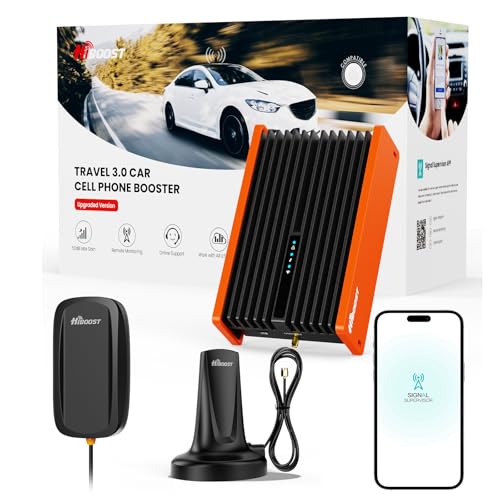
HiBoost offers a precision-grade car booster that emphasizes low signal loss through 50-ohm RF connectors, improving overall efficiency and range. The honeycomb briquette-style housing aids heat dissipation by about 30%, which can help sustain performance in longer drives or warmer climates. The unit is designed to work with all major U.S. carriers and supports 5G as networks continue to expand. Its balanced approach targets users who want robust performance without excessive complexity.
Key attributes include efficient heat management, broad carrier compatibility, and 5G readiness. Installation considerations involve ensuring proper connector and antenna setup to minimize losses. The design aims to deliver consistent coverage for on-road use, streaming, and calls across various vehicles.
JACOOL Car Cell Signal Booster Kit

JACOOL’s car booster is pitched for trucks, SUVs, RVs, and other off-road vehicles. It supports Band 12/13/17 and is compatible with major carriers like AT&T, Verizon, and T-Mobile. The product emphasizes an AGC (automatic gain control) feature with a maximum gain up to 50dB, an indicator to show connection status, and a sleep mode to reduce power when not in use. Its aluminum alloy construction suggests compact size and good heat dissipation, contributing to longer device life and reliable performance on extended trips.
Potential considerations include ensuring the exterior antenna location receives at least a signal outdoors to maximize booster effectiveness. The device is positioned to help improve calls and data uploads/downloads in moving vehicles and in areas with weak signal.
WeBoost Drive Reach OTR

The Drive Reach OTR targets trucks and SUVs with a focus on long-range signal reach and compatibility with all U.S. carriers. It emphasizes the latest 5G technology support and is made in the U.S., with FCC approval. The system is designed to maximize signal reach to multiple devices inside the vehicle, addressing common issues like dropped calls and slow data in rural or challenging coverage areas.
Considerations include the balance between antenna placement, vehicle type, and typical travel routes. The kit’s performance benefits are amplified in regions with sporadic service, where maximizing the strength of inbound signals can deliver more reliable connections for several users simultaneously.
Buying Guide: Key Purchase Considerations And Comparisons
- Carrier compatibility and bands: Ensure the booster supports the bands used by your primary carriers (Band 12/13/17, 5, 2/25, 4, etc.). 5G compatibility is increasingly important as networks expand.
- Vehicle type and usage: For everyday commuting, a compact, easy-to-install unit may suffice. For trucks, SUVs, or off-road use, prioritize rugged mounting and outdoor antennas.
- Outdoor vs. indoor antennas: Outdoor/vehicle antennas generally offer better signal reception. Magnetic or roof-mount options can influence installation ease and effectiveness.
- Gain and coverage: Higher gain (dB) can boost signal more, but real-world performance depends on location, existing signal, and antenna setup. Typical ranges vary from small cars to large RVs or commercial vehicles.
- Power and indicators: Look for automatic gain control, power efficiency features, and status indicators to monitor performance and troubleshooting needs.
- Regulatory compliance: Ensure the product is FCC approved for in-vehicle use to avoid interference and compliance issues.
- Installation complexity: Some kits require professional installation or precise antenna alignment. Consider user manuals and customer support availability.
- Environment and weather durability: For off-road or rural usage, choose devices with durable housings and weather-resistant components.
- Multi-user support: If multiple occupants rely on data and calls, pick boosters designed to handle simultaneous connections.
- Upgrade path: If network infrastructure evolves, a booster with broad band support and easy firmware updates helps future-proof your investment.