Finding a reliable 120V car power adapter is essential for charging laptops, phones, and other electronics while traveling. This guide highlights top-rated 12V-to-110V/120V inverters that maximize safety, efficiency, and practicality for American drivers. Each option combines multiple outlets, USB ports, and smart protections to keep devices powered during road trips, commuting, or camping adventures. Read on to compare features and choose the best fit for your vehicle and devices.
| Product | Brand | Output | USB Ports | Key Benefit |
|---|---|---|---|---|
| PiSFAU 200W Car Power Inverter | PiSFAU | 12V to 110V AC | 4 USB ports (including USB-C) | Compact, quiet, versatile outlets |
| Ampeak 150W Car Power Inverter | Ampeak | 12V to 120V AC | 2 USB ports | Strong protection suite, reliable USB charging |
| FOVAL 200W Car Power Inverter | FOVAL | 12V to 110V AC | 4 USB ports combined | Lightweight with multiple outlets |
| BESTEK 300W Power Inverter | BESTEK | 12V to 110V AC | 2 USB ports | Heavy-duty, high continuous power |
| ALLWEI 300W Power Inverter | ALLWEI | 12V to 110V AC | PD USB-C 27W, USB-A 18W | High-speed charging with PD USB-C |
Note: All products listed here are designed to convert 12V vehicle power to household-style 110V/120V AC outlets, enabling compatibility with a wide range of electronics. They also offer built-in protection to guard against short circuits, overvoltage, and overheating. The selection prioritizes multi-port charging, safety features, and portability for American road users.
PiSFAU 200W Car Power Inverter

The PiSFAU 200W car power inverter converts DC 12V to AC 110V with two U.S. standard outlets and four USB charging ports, including USB-C. It supports devices such as laptops, tablets, and smartphones, making it suitable for travel, gifts, and light-duty home use while parked or on road trips. The unit emphasizes quiet operation and an efficient circuit design to reduce heat and noise. Its compact size—about the dimensions of a cellphone—facilitates easy storage and portability in the vehicle.
Ampeak 150W Car Power Inverter

The Ampeak 150W inverter provides 12V DC to 120V AC conversion with 4.8A dual USB ports. It includes 11 layers of protection to safeguard both the inverter and connected devices, making it suitable for laptops, phones, lighting strings, and other small electronics in cars, RVs, trucks, or during road trips. A lower wattage profile helps with efficiency, while the built-in protections help manage common electrical issues encountered in mobile environments.
FOVAL 200W Car Power Inverter
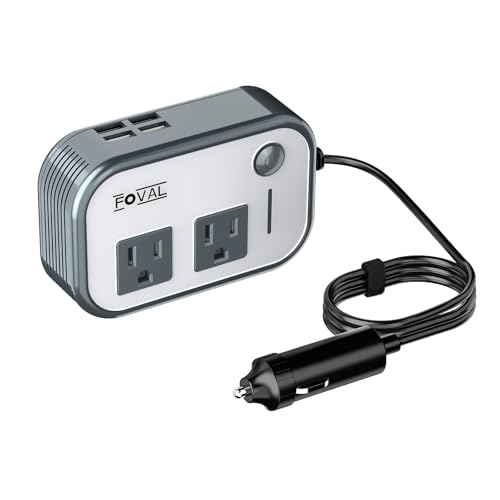
The FOVAL 200W inverter features two AC outlets and four USB ports (a mix of fast-charging options and standard ports). With 12V to 110V conversion, it supports devices such as laptops, tablets, and small home appliances. The unit is designed for portability and storage, weighing about 8 ounces and measuring compactly like a credit card in profile. It includes a smart cooling approach to balance performance and heat management during operation.
BESTEK 300W Power Inverter

The BESTEK inverter emphasizes higher continuous power (300W) with 700W peak capacity, two AC outlets, and two USB ports for charging. It is designed to support larger devices such as laptops and tablets on road trips, camping, or long commutes. As a long-standing inverter manufacturer, BESTEK highlights its compact plug-and-play design, rugged build, and a cigarette-lighter connection aimed at compatibility with most vehicles. The unit is positioned as a versatile all-purpose car power solution.
ALLWEI 300W Power Inverter

ALLWEI’s 300W inverter combines a car plug-in outlet with PD USB-C (27W) and USB-A (18W) ports, enabling fast charging for modern devices while powering two AC outlets. The aluminum housing provides durable heat dissipation, and the built-in intelligent chips help prevent overheating, undervoltage, overcurrent, and other common electrical issues. This unit is well-suited for road trips where multiple devices—laptops, phones, tablets—need simultaneous power without sacrificing safety or performance.
Buying Guide: Key Purchase Considerations
- Power rating: Choose a unit with continuous wattage above your typical load. Devices like laptops and CPAP machines may require higher continuous power than occasional charging USB devices.
- Outlet configuration: If you frequently run laptops, cameras, or monitors, look for multiple AC outlets and sufficient USB ports (including USB-C Power Delivery) for fast charging.
- USB charging speed: PD USB-C ports offer the fastest charging for newer devices. Ensure total USB output aligns with your charging needs.
- Safety features: Look for short-circuit, over-voltage, over-temperature, overload protections, and built-in fuses or cooling fans to reduce risk in a vehicle environment.
- Size and portability: A compact unit is easier to store in a glove box or center console, but ensure it still provides adequate cooling for longer use.
- Heat management: Inverters generate heat; models with efficient fans or heat sinks help maintain performance and device safety.
- Durability and build: Aluminum housings and rugged construction extend the lifespan in mobile settings.
- Vehicle compatibility: Some vehicles have weaker electrical systems; ensure your inverter’s startup and peak load align with your car’s capabilities.
- Use-case alignment: For casual travel, a smaller inverter with USB-C charging may suffice; for camping or work on the road, a higher wattage unit with multiple outlets is advantageous.
The 5 selected products cover a range of use cases—from compact models suitable for occasional USB charging to high-wattage units capable of powering laptops and heavy devices. When evaluating options, prioritize wattage headroom, charging speeds, and safety protections to ensure reliable performance across different travel scenarios.